
What do we need to know about the current energy performance of buildings?
At the end of December, a group of companies and trade bodies published a report on the energy performance of buildings. Its aim is to highlight the flaws in the current thermal regulations, RT 2012, by pointing out the differences between the reality observed on site and the theoretical calculations.
The group behind the study comprises the Alearisque cluster, the Mur Manteau group, the Syndicat National des Bardages et Vêtures Isolées (SNBVI), the Fibres-Energivie cluster, the manufacturers Étanco and Schoeck France, and the engineering consultancies Medieco and Pouget Consultants.

In broad terms, the report stresses the consequences for health (indoor air pollution) and for the economy (heating bills, renovation costs) that a poor building envelope can have. It puts forward solutions for improving the quality of construction, such as more extensive use of BIM, the introduction of commissioning, and a new calculation system for the future thermal regulations that would help reduce thermal bridges.
You can download the 36-page white paper here. Here is a summary.
A high-performance building envelope pays for itself
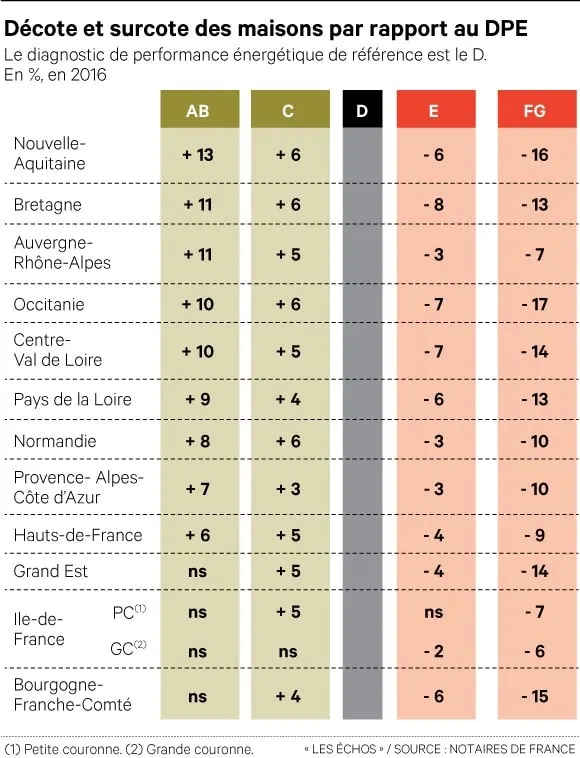
Carried out in 2016 by the Notaires de France, this study highlights the significant impact of a building's energy performance on its property value. It is worth noting that, even though renovation work can be extensive (external wall insulation, for example), the difference between the cost of the renovation works and the rise in property value is positive. In other words, you will make more money by selling a renovated property than by selling it as it stands and leaving the new owner to carry out the renovation.
Treating thermal bridges can halve a building's heat loss
In business there is a golden rule: to start making money, you first have to stop losing it. Likewise, in political speeches, cutting public spending is often put forward as a way of cutting taxes.
The same goes for a building. To start reducing its energy needs, you first have to stop losing the energy you have inside. Moreover, while replacing a radiator or a hot water cylinder is easy, replacing the insulation in a wall is far more complicated and, above all, costly. The challenge is therefore to invest in insulation that lasts, such as cellular glass insulation rather than glass wool.
The second lever is, of course, the building services, where the aim is to optimise their efficiency and size them correctly. Note that with a high-performance building envelope, the amount of equipment required can be reduced accordingly.
You cannot always make something new out of something old
When you have a thermal sieve, you can treat it with external wall insulation. However, many elements, such as balconies, will struggle to be cured of their energy deficiencies. It is therefore vital to build well from the outset in new construction.
It is worth knowing that 46% of the costs of a new building are incurred after the construction phase. As a reminder, here are the main items of expenditure for a new-build project:
- 11% for land costs
- 28% for construction costs
- 15% for financing costs
- 12% for maintenance costs
- 34% for running costs
Thermal bridges degrade indoor air quality
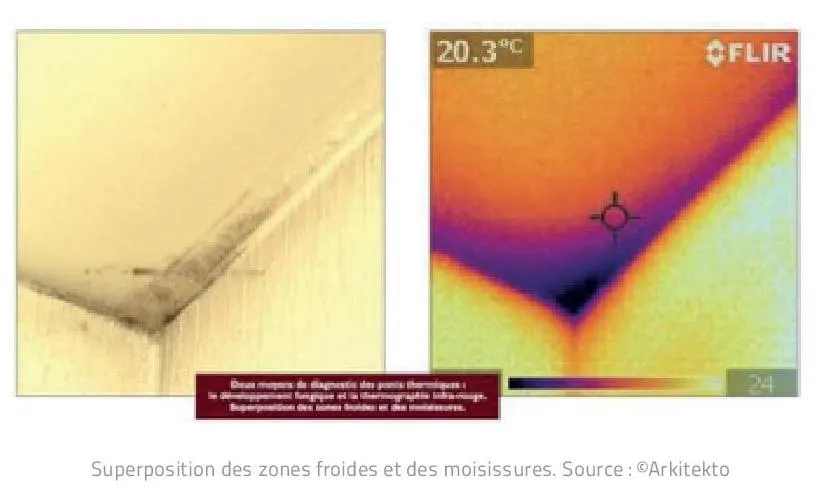
When the water vapour in the air comes into contact with a cold wall, it can cause condensation, which in turn encourages mould growth. Mould is harmful to human health: it causes rhinitis, allergic bronchitis, asthma and a number of allergies. Although the study is starting to date, having been carried out between 2003 and 2005 by the Observatoire de la Qualité de l'Air Intérieur, it found that 37% of homes in France have mould.
The socio-economic cost of indoor air pollutants is estimated at around €19 billion a year.
The basic method for calculating heat loss needs rethinking.
Today, sizing is done by adding up each zone and then, as a safety margin, adding 20% to the output of the generating plant. The result is that most heat-generating equipment runs at very low part load, even below its minimum threshold.
To solve this problem, the study group proposes giving more weight to the dynamic dimension in the sizing calculations for HVAC equipment.
Being more vigilant about building defects
Building pathologies continue to grow. Among the contributing factors is the care taken on site. The authors of the study explain in particular that it is not uncommon to see insulation getting wet on site before it is installed. In addition, from a theoretical point of view, the calculations do not give enough credit to the quality of workmanship.
The study on the building envelope recommends a better analysis of defects, pathologies and excess consumption in buildings in use, so that practices can evolve.
An average is not good enough for insulation
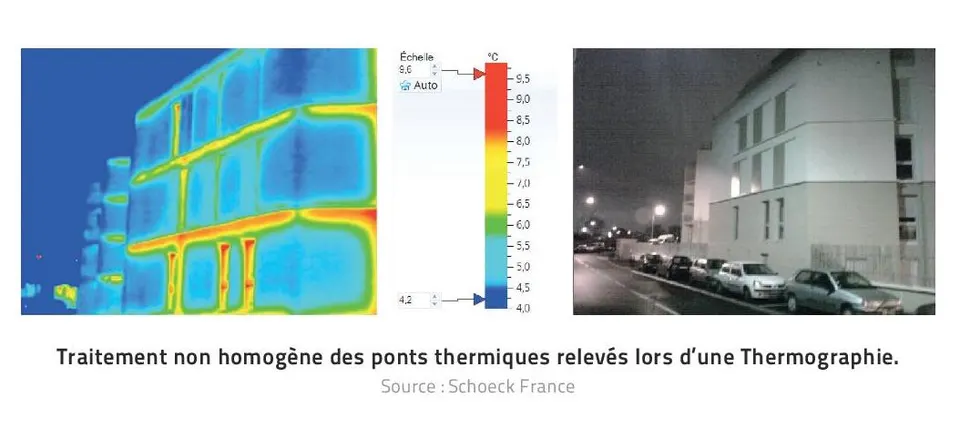
The calculation methodology for thermal performance under RT 2012, using the B_bio coefficient, tolerates a dwelling having a poorly insulated room. The method works by averaging across the whole dwelling. This favours the presence of thermal bridges or poorly performing areas, as long as part of the building performs well. The drawing below illustrates this.
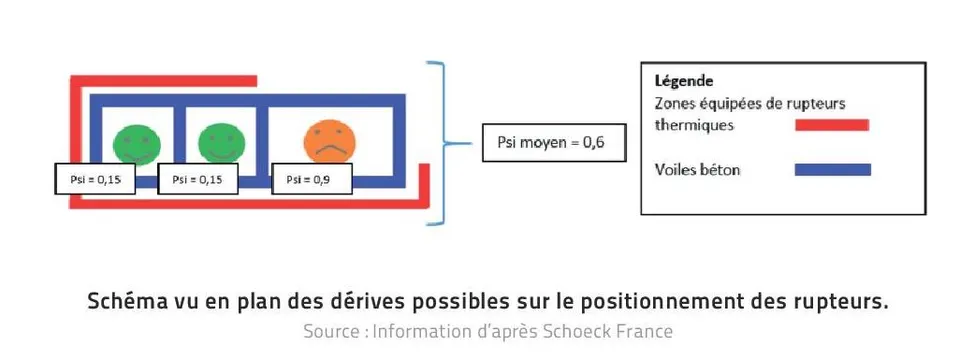
The authors of the study recommend reintroducing a coefficient of the U_Bat type, which featured in RT 2005, to guarantee more uniform insulation across the building fabric.
Introducing commissioning to improve the quality of buildings
Commissioning provides a framework for understanding possible errors and for coordinating the actions needed to address them. It is a quality process that runs from design through to operation of a building.
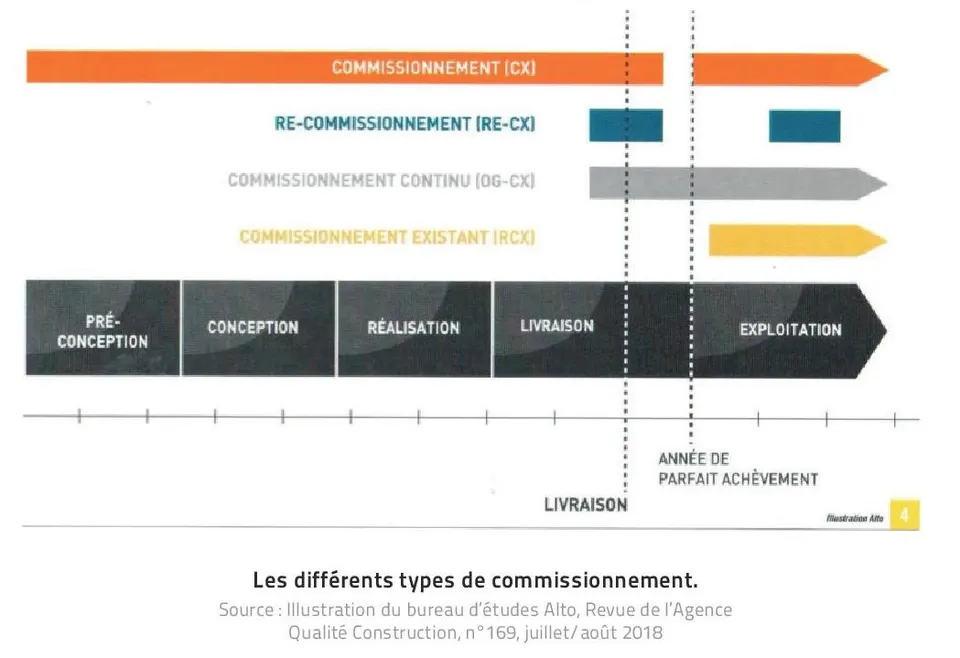
The authors of the study recommend a commissioning tool, as has been done in Germany. This tool is also beneficial economically, because it reduces the risk of claims and the extra costs that result from them.
Extending the digital model to construction sites
We hear a great deal about BIM, which sums up the digital transformation of the construction industry. In practice, however, although it is beginning to be introduced at the design stage, it is not always carried through to the construction phase. The Fibres-Energivie cluster recommends tracing the various elements of the works on site, using RFID tagging in particular, to ensure quality monitoring of construction. This monitoring could also make it possible to feed back qualitative data that is useful to everyone.