
Result of the EUROPAN 2010 competition for France
The competition was launched in January 2009 in 19 European countries, with 4,219 registrations, including 2,429 teams of entrants under 40. Competitors were given a wide variety of sites, linked by shared themes such as the conversion of cities, sustainable development, the appropriation of the city by its residents and the enhancement of natural resources. Before the launch, a European debate on the sites took place at the Forum des Sites in Paris in November 2008, to compare them, group them into thematic families and enrich the issues they raise.
123 teams were awarded prizes, comprising 414 members, 17 of them French teams. The prizewinning teams are made up of 308 architects, 19 architect-urbanists, 4 urban planners, 18 architect-landscape architects, 2 landscape architects, 1 environmentalist, 8 engineer-architects, 6 engineers, 3 graphic designers, 2 historians, 1 artist, 1 economist, 1 film-maker and 53 architecture students. Each country chooses when it will present its prizes, but a Europe-wide ceremony will take place on 28 and 29 May 2010 in Neuchâtel.
Alès
The winning project is ZIG-ZAG, by Augustin Cornet and Chloé Duflos (MUZ Architecture).
Transport and density: faced with their new territorial and metropolitan dimensions, cities are having to look afresh at the relationship between transport and density. In this respect, the railway land of the Alès marshalling yard, both a mobility space and a land reserve, holds strong potential for urban development.
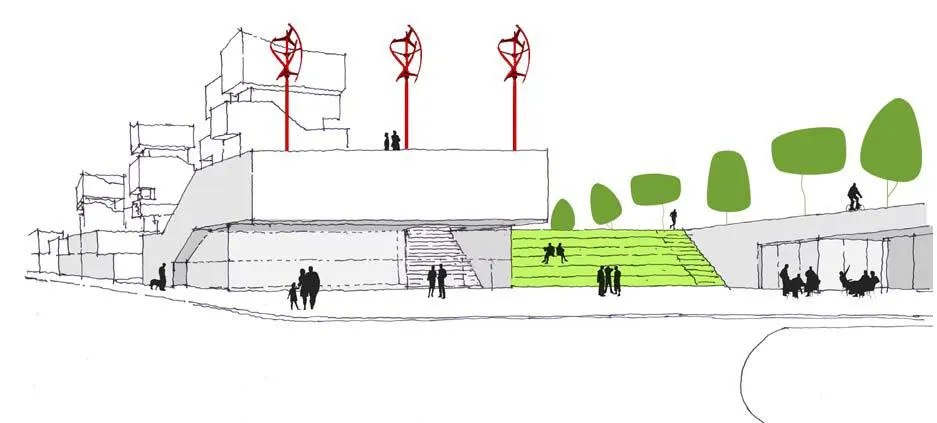
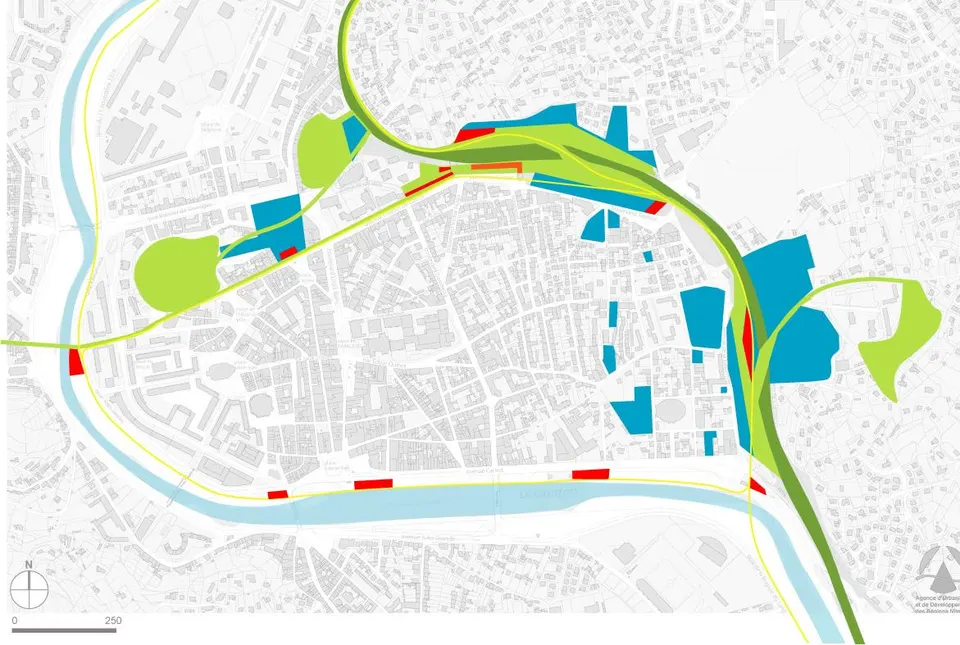
A new outlook on infrastructure: the project takes a fresh look at the railway infrastructure that encircles Alès, proposing a city-scale public space that recognises the potential of this land reserve while fully embracing the presence of the tracks.
A unifying park in the town centre: this new space takes the form of a large zigzag-shaped urban park, creating a unifying urban entity by making the most of the site's topography. By folding and rising, the garden's ground plane links the different parts of the city, crossing the tracks gently without denying them. It stages long views towards the Cévennes massif, which enter into dialogue with the railway landscape.
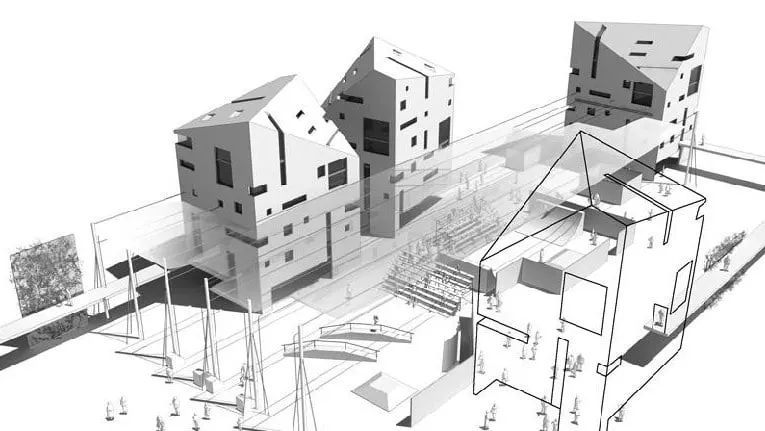
Programmatic complexity: the garden's artificial topography is inhabited by the many programmes that will animate the new centre around the multimodal interchange: city-scale car parking, facilities that anchor the park to the adjoining neighbourhoods (sports hall, shops, hotel, Maison du Développement Durable), and a new offer of attractive housing along the park's edge.
A sustainable urban structure: the park also links a string of existing green spaces, creating a landscape structure intended to become the catalyst for Alès's development along its SNCF lines, and to present this periphery not as a break but as a new linear centrality.
Dunkerque
The winner in Dunkerque is the project ACTE 1 : ENTREZ EN SCENE (ACTE 1: COME ON TO THE STAGE), by Vincent Barué, Etienne Bourdais and Nicolas Boutet.
At the convergence of territories and amid Dunkerque's major restructuring programmes, Môle 1 sits at the junction of several urban landscapes. The project "Acte 1 : Entrez en scène" first proposes to disconnect the mole from its surroundings in order to give it the identity of an island, reinforcing the presence of water and its belonging to Dunkerque, a port city laid out along the sea.
The defining components of Môle 1 – factories, storehouses, halls – are refurbished and cleared of a few less significant buildings. Light installations, or "plugs", are then added to them, in keeping with the logic of this industrial heritage. Before a succession of shifting landscapes and horizons, Acte 1 sets the mole in front of a new urban and industrial stage, dynamic and interactive, radiating across a wide territory.
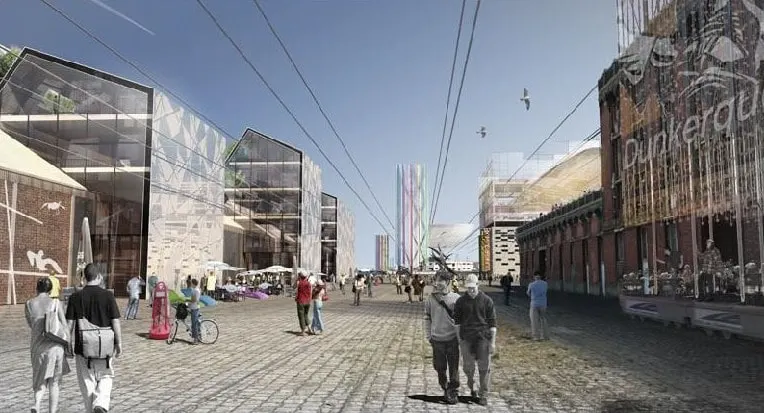
Visible from the town centre, this stage is animated by numerous communicating and playful elements, bringing the site to life by day and by night. The people of Dunkerque then step on stage at the heart of the mole and, through the variety of activities on offer, become its main players.
Isle-d’Abeau
The winning project is UN SCENARIO D’ETABLISSEMENT HUMAIN (SCENARIO FOR A HUMAN ESTABLISHMENT), led by Samuel Martin and Christophe Duburcq.
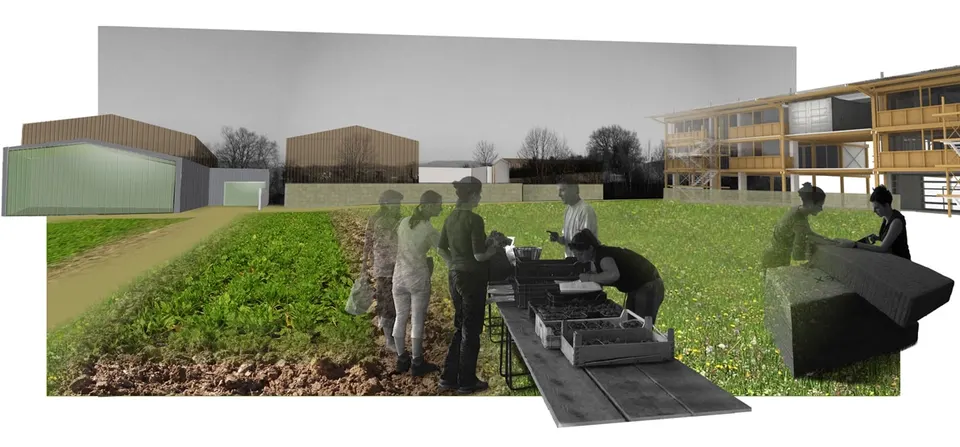
The creation of a mixed-use neighbourhood around L'Isle-d'Abeau station raises a broader question about the urban reality of a territory in search of an identity: yesterday a "Ville Nouvelle" urbanised at breakneck speed, today a fragmented peri-urban area subject to the logics of metropolisation and the spread of housing. In this context, the main challenge for the new neighbourhood must be to initiate a different mode of development, capable of bending current trends in mobility, territorial identity and residents' habits.
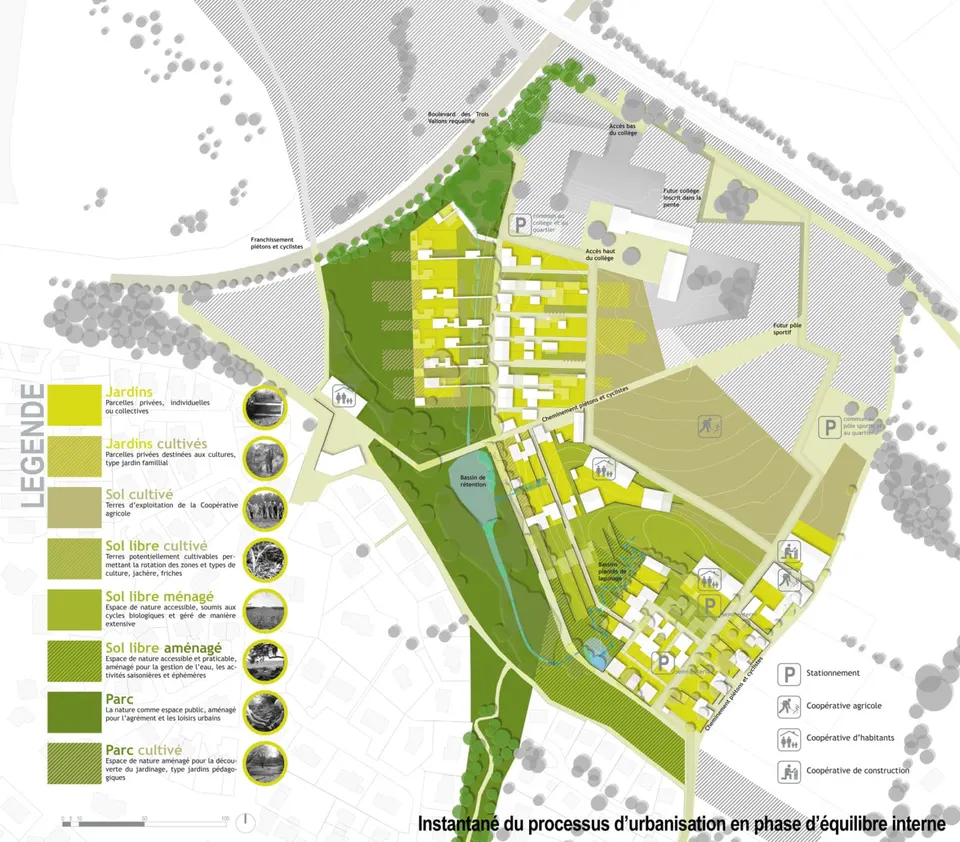
Our fundamental hypothesis is that it is possible to overcome the apparent antagonism between the metropolitan context and the local project, by favouring the search for contextual solutions to the global challenges of sustainable development. Our proposal therefore starts from existing territorial values in order to recreate, locally, the conditions for a concrete experiment in the sustainable city.
This deliberately open and forward-looking approach breaks down into three strategic strands intended to ensure the project's spatial and temporal continuity:
- the geographical restoration of an agricultural territory of plateaux, hillsides and water-shaped valleys;
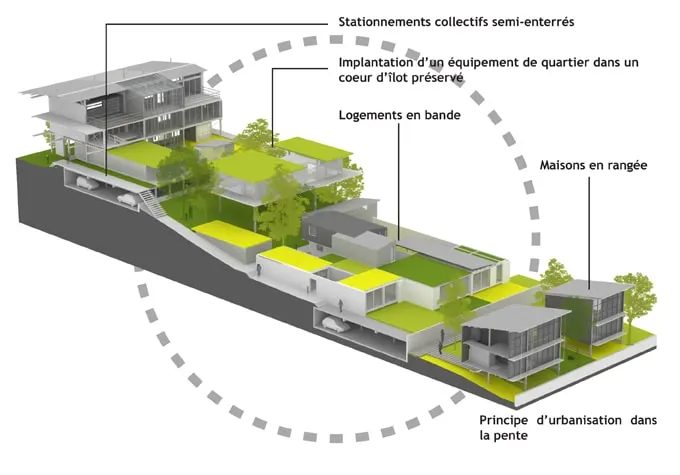
- the organisation of public spaces to encourage local mobility and re-establish a neighbourhood scale;
- the implementation of a cooperative project, able to relocalise the social, cultural and economic exchanges of the future residents.
Triel-sur-Seine
The winners are Valérie Helman and Magali Euverte for the project FIELD WORK, with contributions from Isabelle Kite, Séverine Lucas, Delphine Rudaux and Viviana Comito.
A walk around the loop of the Seine immediately reveals the potential and the difficulties of the Triel site. On the one hand, the Seine is close at hand in every direction, there is a local tradition of market gardening, and the fields allow the geography to be read: hillsides, meanders, horizon. On the other, there is isolation, the communes' back-of-town position, and the visual pollution and poor range of uses generated by single-function zones.
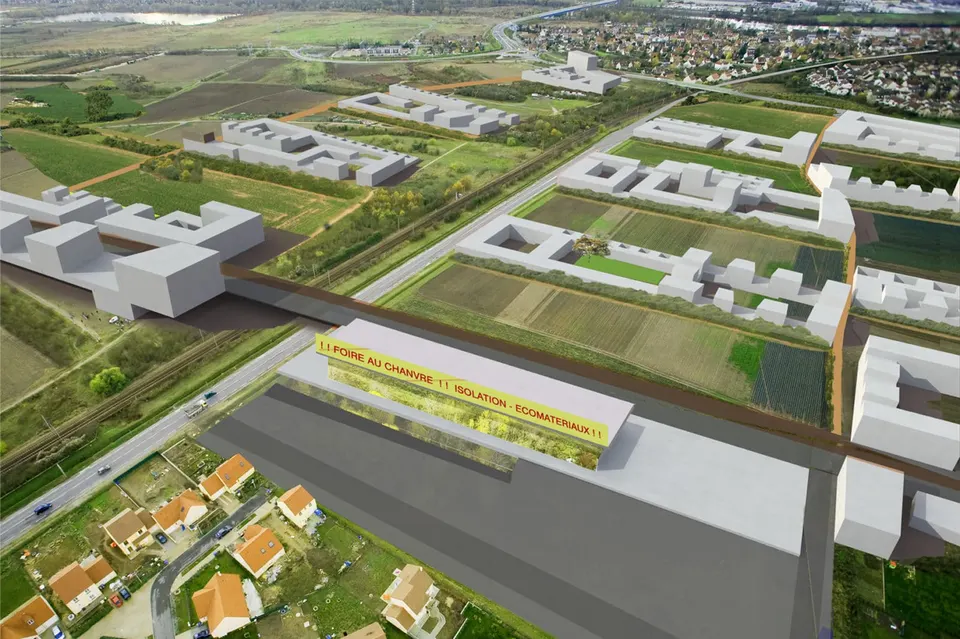
The project sets out to address Europan's issues while drawing on this potential. It seeks a mode of urbanisation that does not harm landscape continuities, and explores what makes housing in the outer suburbs attractive. The project is organised around four figures:
The heart of the loop
Establishing a centrality beyond the site, edging it, linking it to the distance, giving it a distinctive urban fabric, and making it possible to reach the Seine via a network of paths.
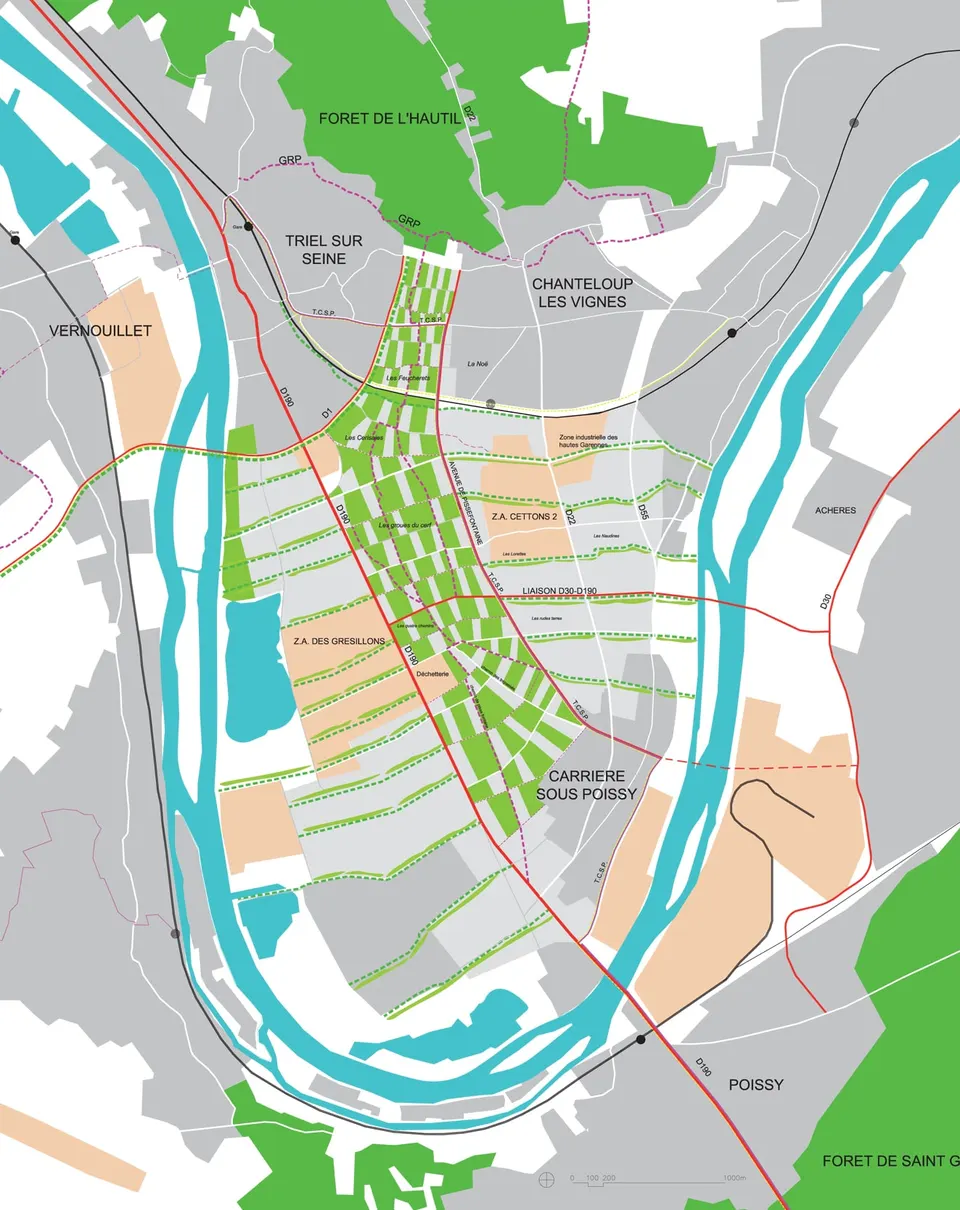
An agricultural and urban chessboard
This fabric manages landscape and ecological continuities, multiplies views into the distance, limits public spaces that are costly for local authorities, strengthens local farming and absorbs the uncertainties of phasing.
Bastides
Continuous, compact buildings follow one another in successive courtyards and define a clear boundary between built form and nature. The scale of the plots (around 60 families) allows for shared spaces and pooled uses, but also for a mix of activities (including farms) sited according to circumstances.
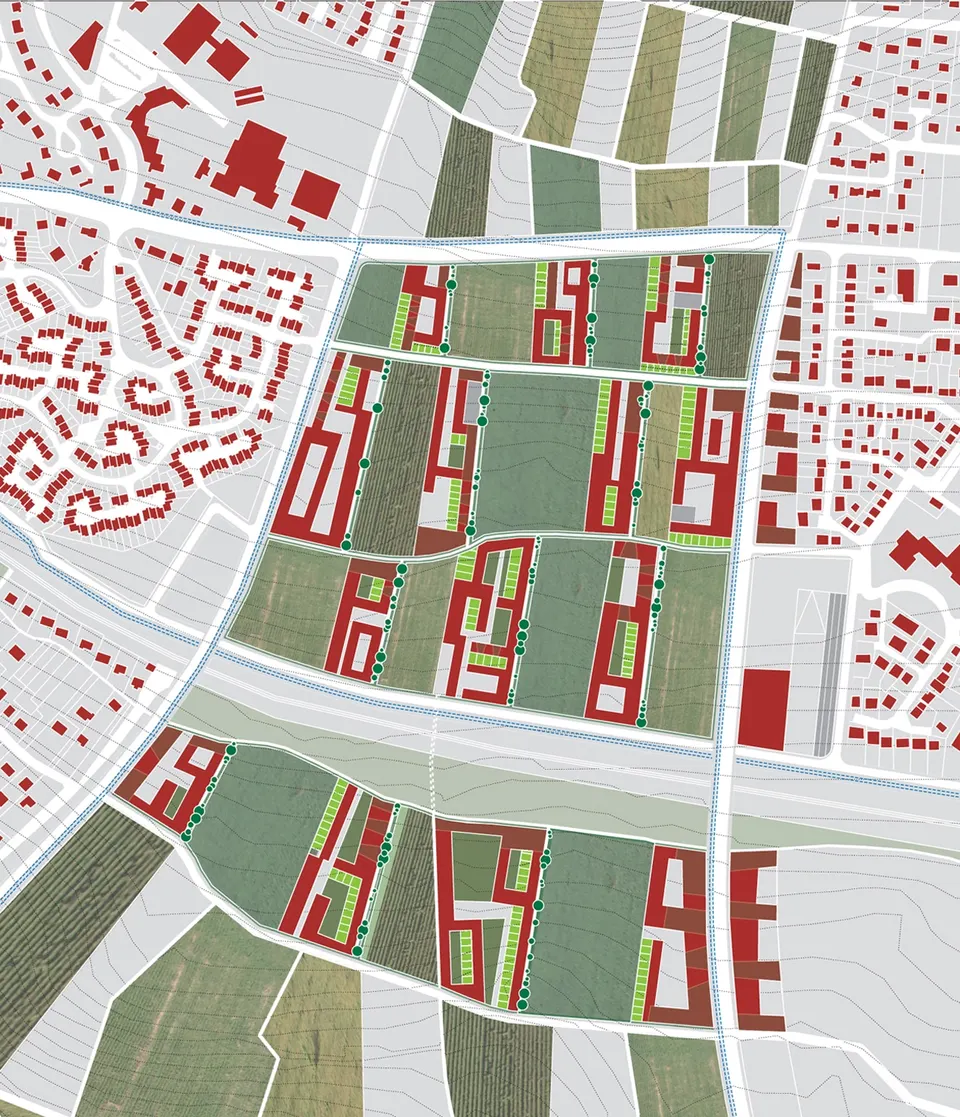
Housing between courtyard and garden
All the dwellings have an open-air outdoor space. The types, variations on the house, differ according to their orientation and position within the plot and are built in timber and cob.