Applicants' worries about getting into architecture school
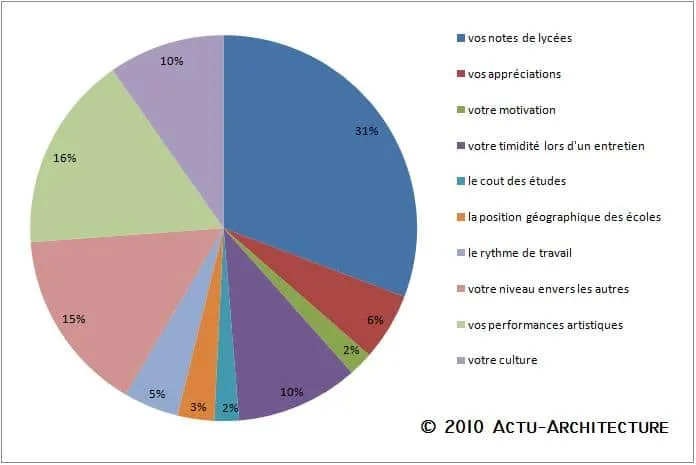
Just before Christmas, I ran a survey of applicants to architecture schools, and now it is time to share the results. Respondents could choose two answers from the ten on offer. The results I am presenting exclude the 65 blank votes and take into account only the 195 valid ones.
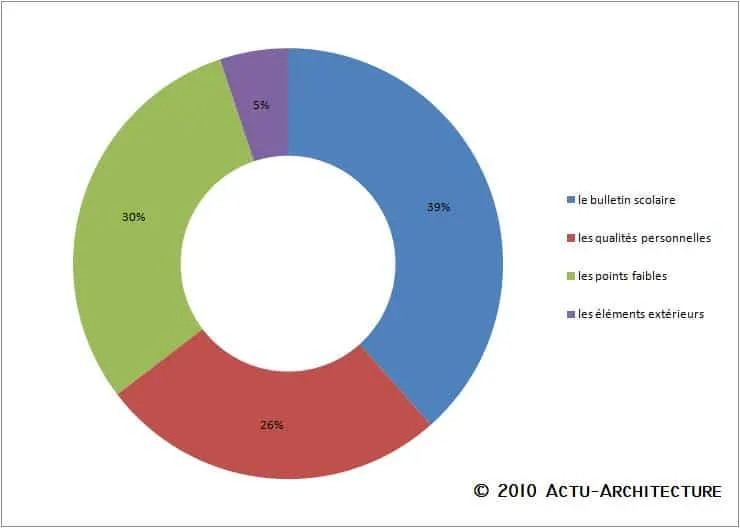
In my second chart, I grouped the various options into four categories. It shows clearly that external factors such as the location of the schools or their cost do not frighten applicants, even though model-making alone can cost around €30 a month. It is also reassuring to see that school grades do not command an overwhelming majority: other factors, such as culture and the artistic side, are very much present. It is proof that architecture is not a profession that boils down to A+B=X, but one that is wide open to life. As Victor Hugo put it: "Architecture is the great book of humanity, the principal expression of man in his various stages of development, whether as force or as intelligence."
However motivated some applicants may be, the schools' average admission rate is only around 10%, so many have a plan B. Some school leavers turn to a MANAA foundation year; others opt for a year of art history at university, which I do not think is one of the best things to do. There are two other routes that are often taken, and which I find both justified and interesting. The BTS Design de l'Espace, besides building a good command of the pencil, develops artistic creativity. The DUT Génie Civil offers a pragmatic view of architecture: you learn construction techniques, and the tricks of the trade too. Projects will be more feasible and probably cheaper, just as Renzo Piano and Richard Rogers admitted that the Centre Georges Pompidou would have cost far less had they known the tricks of the building trade. That said, if you fail the schools' entrance tests, I would say it is not that serious. Let me explain: some schools like to keep a certain level of maturity and do not hesitate to favour students over school leavers. Failing can, on the contrary, be an opportunity to look into other things and build a broad culture, because architecture is not only architecture; it is also photography, painting, music, cinema, theatre and so on. The jury greatly appreciates travel.
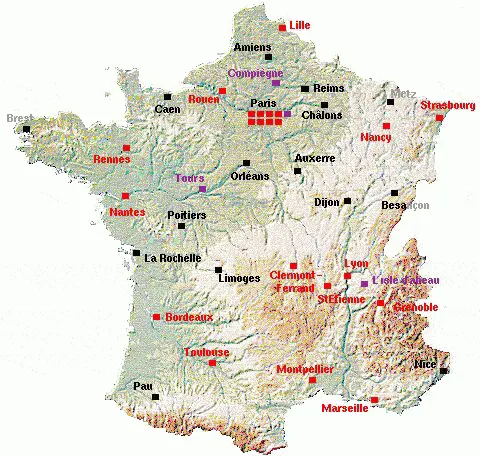
This year, the schools of architecture have adopted the "admission post-bac" procedure, the government portal for managing school-leavers' applications after the baccalauréat. The pre-registration period is about to end, with the deadline falling on 20 March. After this stage, each school is free to run its own recruitment: most, such as the schools of architecture in Nantes and Lille, hold an interview, while others, such as those in Lyon and Grenoble, set written tests. These may include a drawing test and tests of architectural history and technology. Grenoble has one particularity: it selects 40 applications without holding an interview.